Skip to content
georgiapropertydeed.com

Georgia Transfer-on-Death Deed Name a Beneficiary, Skip Probate

Get your transfer-on-death deed in 2 business days. Sign from home. Return by FedEx for recording.

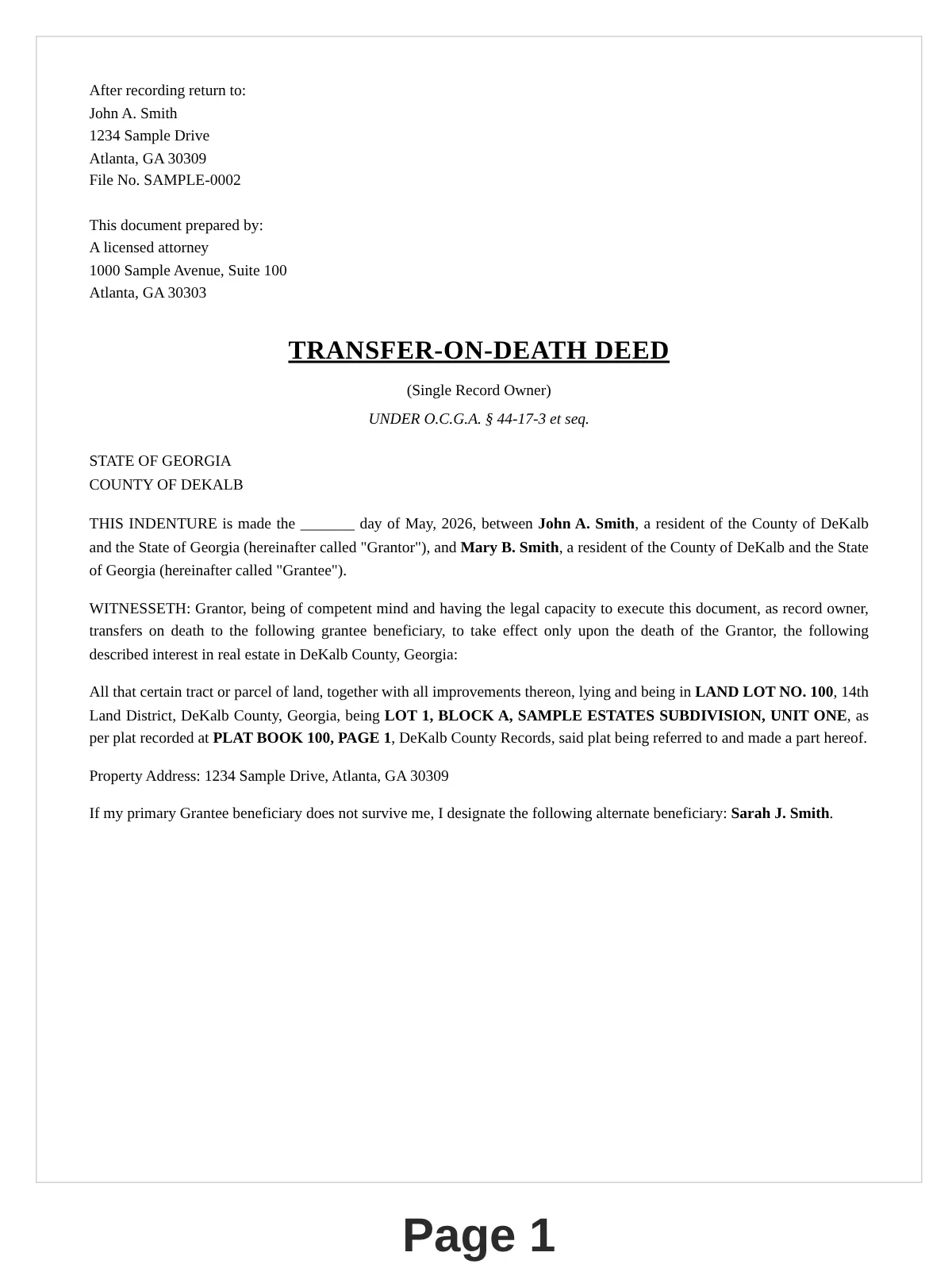
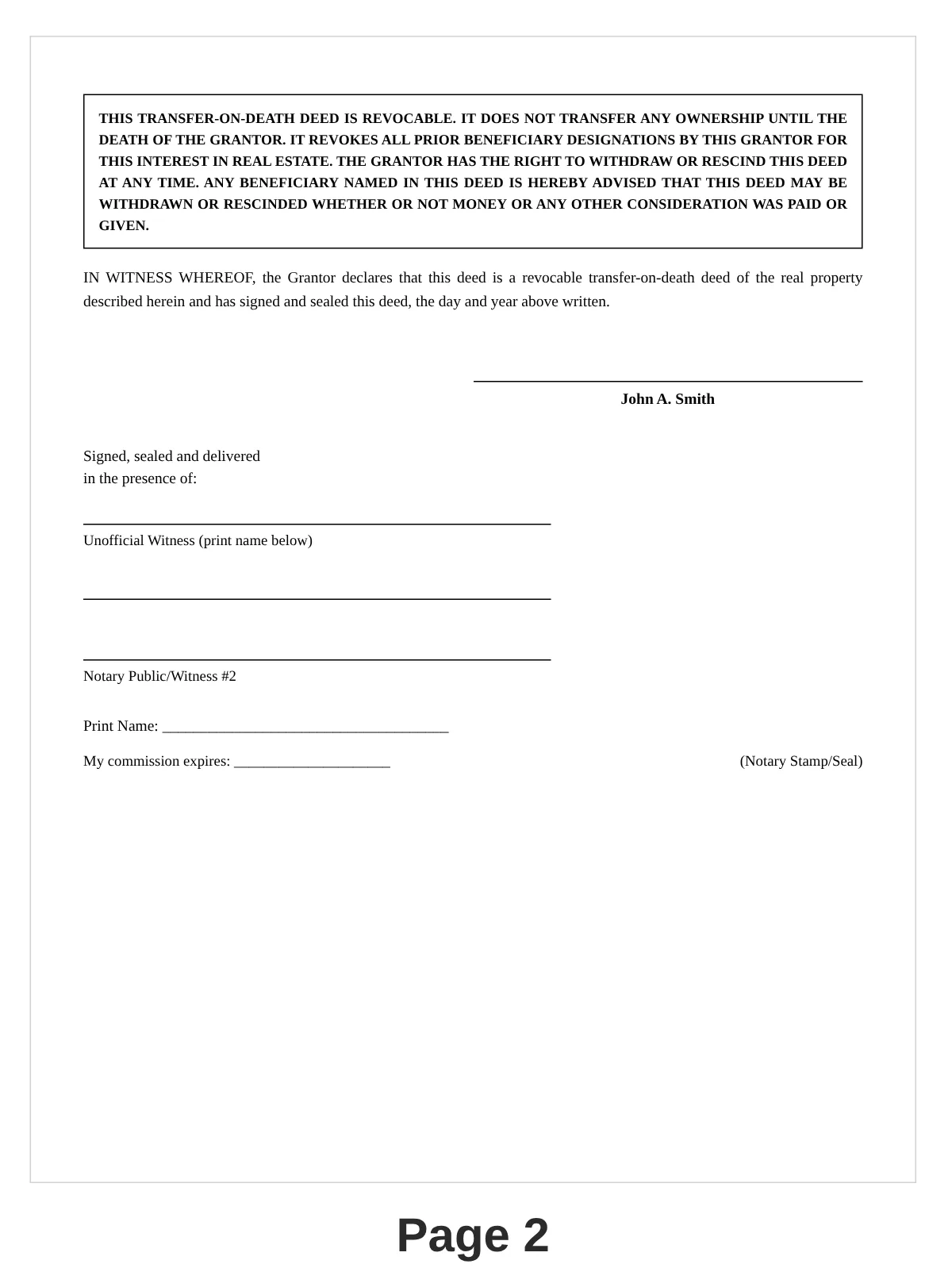
Sample Georgia transfer-on-death (TOD) deed — annotated example showing owner, named beneficiary, legal description, and revocability clause under Georgia’s transfer-on-death deed law (O.C.G.A. Title 44, Chapter 17)

Sample only — names, addresses, and parcel numbers are fictional. Every deed we deliver is drafted by a licensed attorney.

Attorney-prepared deeds

Every deed is drafted by a licensed attorney. Title-reviewed and recorded by our team.

Clear flat-rate pricing

$249 flat fee. Add Mobile Notary for $150 if you want us to send a notary to you. No hidden fees.

100% remote — no office visits

Skip the courthouse trip. Deed delivered by email. Sign with any notary. Return by FedEx for county recording.

What is a Transfer-on-Death deed?

A Transfer-on-Death deed — sometimes called a "TOD deed" or "beneficiary deed" — names a person who will automatically own your Georgia property the moment you die. You don't give up anything during your lifetime. You still own it. You can sell it, refinance it, rent it, or revoke the TOD deed any time, without your beneficiary's permission.

The transfer only happens when you die, and only if the TOD deed is still on record at that time. Your beneficiary doesn't need to go through probate to receive the property — they file a death certificate and the appropriate affidavit with the county, and title is theirs.

Georgia recognized TOD deeds through O.C.G.A. Title 44, Chapter 17 (enacted by SB 420), which took effect July 1, 2024. Before that date, a Georgia homeowner who wanted to pass real estate outside probate had to rely on a will (which still triggers probate), a living trust (expensive, complex), or a quitclaim during life (which gives up control and creates adverse tax consequences). TOD deeds are cleaner.

Why Georgia homeowners use TOD deeds

Avoid probate

Probate in Georgia can take 6–12 months and cost thousands in court fees and attorney time. A TOD deed bypasses probate entirely — your beneficiary receives the property with a death certificate and the appropriate affidavit.

Far cheaper than a trust

A living trust costs $1,500–$3,000 to set up and requires re-titling every asset. A TOD deed costs $249 and does the same job for a single property.

Fully revocable

Change your mind? Change beneficiaries? Sell the house? Do any of the above without anyone's permission. You remain the sole owner.

Simpler than a will

Wills still go through probate. A TOD deed bypasses probate completely for the property it covers.

How we prepare your TOD deed

Three steps. Start to finish in about 2 weeks.

  1. takes ~5 minutes

    Step 1 — Share property and beneficiary details

    Complete our online form: property address, current owner's name, and who you want to name as beneficiary (or beneficiaries — you can name more than one).

  2. ready in 2 business days

    Step 2 — Receive your TOD deed

    We review your property record, prepare a TOD deed that meets Georgia's statutory requirements, and email it to you with clear signing instructions.

  3. recording up to 1 week

    Step 3 — Sign, notarize, and we record it

    Sign in front of a notary and one witness (Georgia's execution requirement), ship it back using our prepaid FedEx label, and we file it with your county clerk. A recorded copy arrives by email when it's official.

TOD deed vs. the alternatives

  TOD Deed Will Living Trust Joint Tenancy
Avoids probate
Cost to set up $249 $500–$1,500 $1,500–$3,000 Deed fee
You keep full control while alive Partial ✗ (shared)
Can be revoked anytime ✗ (both must agree)
Beneficiary creditors can reach it now
Good for single property Overkill
Good for multiple assets
Requires ongoing maintenance

A TOD deed is the right tool for the simple case: you own a home, you want one person (or a small group) to inherit it, and you don't want them dealing with probate. For larger estates with multiple properties, business interests, or complex beneficiaries, a trust is usually the better fit — and we'll tell you so.

Is a TOD deed right for you?

Good fit

  • Single-family home or one piece of Georgia real estate
  • Clear beneficiary (adult child, spouse, sibling, trusted friend)
  • You want to keep full ownership and control while alive
  • You want to avoid probate for this property specifically
  • The property has no pending litigation or ownership disputes

Not a fit

  • Property is outside Georgia (TOD laws vary state to state)
  • You want the beneficiary to inherit conditions or obligations (use a will or trust)
  • The beneficiary is a minor (needs a trust or guardianship structure)
  • You own multiple properties and want a unified estate plan (trust is better)
  • Ownership is contested or in litigation

If you're not sure, book a free call — 10 minutes on the phone with a title examiner will tell you whether a TOD deed fits.

Simple flat-fee pricing

Recording fees at the county are included. No hidden costs.

Standard

$249 flat fee

Everything you need for a standard Georgia deed transfer.

  • Title search
  • Deed in 2 business days
  • County recording
  • Lifetime customer support
  • ClearPath Guarantee — full refund anytime before recording
Order Your TOD Deed — $249
Mobile Notary Add-On
+$150 added to Standard

$399 flat total

Everything in Standard, plus a notary who comes to you.

  • Georgia notary travels to your home, office, or coffee shop
  • Anywhere in Georgia
  • Evening and weekend slots available
  • You pick the date and place
Deed + Mobile Notary — $399

Standard customers: most banks, credit unions, and UPS Stores notarize free or for a small fee.

Georgia TOD Deed — Frequently Asked Questions

When did Georgia start recognizing TOD deeds?
Georgia's transfer-on-death deed law (O.C.G.A. Title 44, Chapter 17, enacted by SB 420) took effect July 1, 2024. Before that date, TOD deeds were not valid in Georgia and couldn't be recorded. Any TOD deed signed and recorded on or after July 1, 2024 is enforceable under Georgia law.
Does a TOD deed affect my property taxes or homestead exemption?
Generally, no. Because ownership doesn't transfer until death, recording a TOD deed typically doesn't change your homestead exemption or property tax assessment, and because the transfer is revocable and incomplete, it generally isn't treated as a taxable gift during your lifetime.
Can I name more than one beneficiary?
Yes. You can name multiple beneficiaries — as co-owners, in specific shares, or with contingent beneficiaries (who inherit if the primary beneficiary predeceases you). We'll walk you through the options on the intake form.
Can I revoke or change the TOD deed later?
Yes, anytime, as long as you're the sole owner and mentally competent. Revocation is done by recording either a formal revocation document or a new TOD deed that supersedes the old one. We handle revocations and replacements at a reduced rate for existing customers.
Does the beneficiary have any rights while I'm alive?
No. Until you die, the beneficiary has no ownership interest, no right to sell, no right to enter the property, and no right to any rent or income. They also can't be reached by their own creditors through the TOD deed — which is a major advantage over joint tenancy.
What happens if my beneficiary dies before I do?
If you named only one beneficiary and they predecease you, the TOD deed lapses and the property passes under your will or by Georgia intestacy law. You can prevent this by naming a contingent beneficiary on the original deed — ask us about it when you order.
Is a TOD deed better than putting the property in my beneficiary's name now?
Yes, for most people. Adding someone to your deed during your lifetime creates a gift, potentially triggers gift tax reporting, exposes the property to their creditors, and requires their signature to sell or refinance. A TOD deed avoids all of that — you keep full control, and transfer only happens at death.
Do I still need a will if I have a TOD deed?
Yes. A TOD deed only covers the property named in the deed. Everything else — cars, bank accounts, personal property, other real estate — still needs a will (or other estate planning). Think of a TOD deed as one tool in your estate plan, not the whole plan.
How does the beneficiary claim the property after my death?
They typically record a death certificate and the appropriate affidavit (often an "affidavit of survivorship") with the county clerk, outside any probate proceeding. In most Georgia counties, the whole process takes about 2–3 weeks.
Can a TOD deed be contested?
Yes, but it's harder than contesting a will. Like any deed, it can be challenged for fraud, undue influence, or lack of mental capacity at the time of signing. Proper execution (notary + witness) and a clear record go a long way toward heading off challenges — both of which we handle.

What Georgia homeowners say

★★★★★ on Google
See all reviews on Google →
★★★★★
“We needed to make changes to our deed. Living outside of Georgia Todd made this so easy. We are very thank for ClearPath Title.”
Lee F. Verified Google review
★★★★★
“I'd highly recommend these folks for handling a deed transfer/filing. They were very knowledgeable as to the process requirements and attentive to addressing our questions in a very professional manner.”
Mike C. Verified Google review
★★★★★
“Was an easy process. All paper work completed quickly. Have recommended these folks to others.”
Karen M. Verified Google review

Ready to set up your Georgia TOD deed?

  • $249 flat rate
  • Deed in 2 business days
  • 100% remote
  • ClearPath Guarantee

Other Georgia deed types we prepare