Skip to content
georgiapropertydeed.com

Georgia General Warranty Deed — Maximum Title Protection, Flat $249

The strongest deed in Georgia. The grantor warrants the entire title history — every prior owner, every prior period — and stands behind it personally. Flat $249. Your deed in 2 business days. Recorded with the county clerk after you sign.

  • Deed in 2 business days
  • All 159 Georgia counties
  • ClearPath Guarantee

What is a general warranty deed?

A general warranty deed transfers ownership of Georgia real estate with the broadest possible warranty of title. The grantor isn't just promising the title is clean during their period of ownership — they're standing behind the title's entire history, going back to the original land grant.

If a defect surfaces years after closing — a forged signature from 1962, an unrecorded easement, a missing heir's claim — the grantee can come back to the grantor for damages under the warranty covenants. That liability survives closing, doesn't expire, and runs to the grantor's heirs and estate.

Why it's less common in Georgia than you might think

Most Georgia residential closings use a limited warranty deed plus an owner's title insurance policy — not a general warranty deed. The reason is risk allocation: title insurance covers older defects more reliably than chasing down a former seller's heirs decades later. General warranty deeds are typically used when the buyer specifically requests one, in family transfers where the grantor wants to give the strongest possible deed, or in transactions where title insurance is unavailable or undesired.

The six covenants of a general warranty deed

A general warranty deed carries six implied promises (called "covenants") under Georgia law. Together they form the strongest title guarantee any deed can provide.

Covenant of Seisin

The grantor warrants they actually own the property and have lawful possession of the title they're transferring.

Covenant of Right to Convey

The grantor warrants they have the legal authority to transfer the property — no co-owner blocking them, no court order restricting them.

Covenant Against Encumbrances

The grantor warrants the property is free of liens, mortgages, easements, or other encumbrances except those specifically disclosed in the deed.

Covenant of Quiet Enjoyment

The grantor warrants the grantee won't be evicted or disturbed by anyone with a superior claim to the title.

Covenant of Warranty

The grantor agrees to defend the title against any third-party claims — and to compensate the grantee if the title fails.

Covenant of Further Assurances

The grantor agrees to sign any additional documents needed later to perfect the grantee's title.

The first three covenants address the title at the moment of transfer. The last three are forward-looking — they bind the grantor (and the grantor's estate) for as long as a title defect remains undiscovered. That long tail of liability is exactly why limited warranty deeds + title insurance dominate Georgia practice — and exactly why some grantees insist on a general warranty deed when they can negotiate for it.

When to use a Georgia general warranty deed

Buyer demands maximum protection

The buyer specifically negotiated a general warranty deed in the purchase contract — common in some commercial deals, large residential transactions, or when the buyer is unfamiliar with Georgia's limited-warranty norm.

Strong family transfer with consideration

Parent selling to an adult child, sibling-to-sibling sale at fair value, or any family transaction where the grantor wants to give the highest-quality deed possible as part of the family transfer.

Out-of-state buyers

Buyers from states where general warranty is the residential default (Texas, Virginia, North Carolina, etc.) often expect one in Georgia transactions and won't close without one.

Closing without title insurance

Buyer is forgoing owner's title insurance and wants the strongest possible deed warranty as a substitute. Less common, but it happens — especially in cash family sales.

Estate from a long-tenured owner

The grantor has owned the property for decades and is comfortable warranting the entire history because they know it well. Confident estate administrators sometimes use a general warranty for distributions to heirs.

Premium-grade FSBO sale

Seller wants to make the deed itself a selling point — "buy from me and you get a general warranty deed, not a limited warranty." Useful when competing against MLS-listed inventory.

How we prepare your general warranty deed

Three steps. Start to finish in about 2 weeks.

  1. takes ~5 minutes

    Step 1 — Share property and party details

    Complete our online form: property address, grantor (seller), grantee (buyer), and any sale or consideration details. Upload the current deed if you have it — otherwise we pull it.

  2. ready in 2 business days

    Step 2 — Receive your general warranty deed

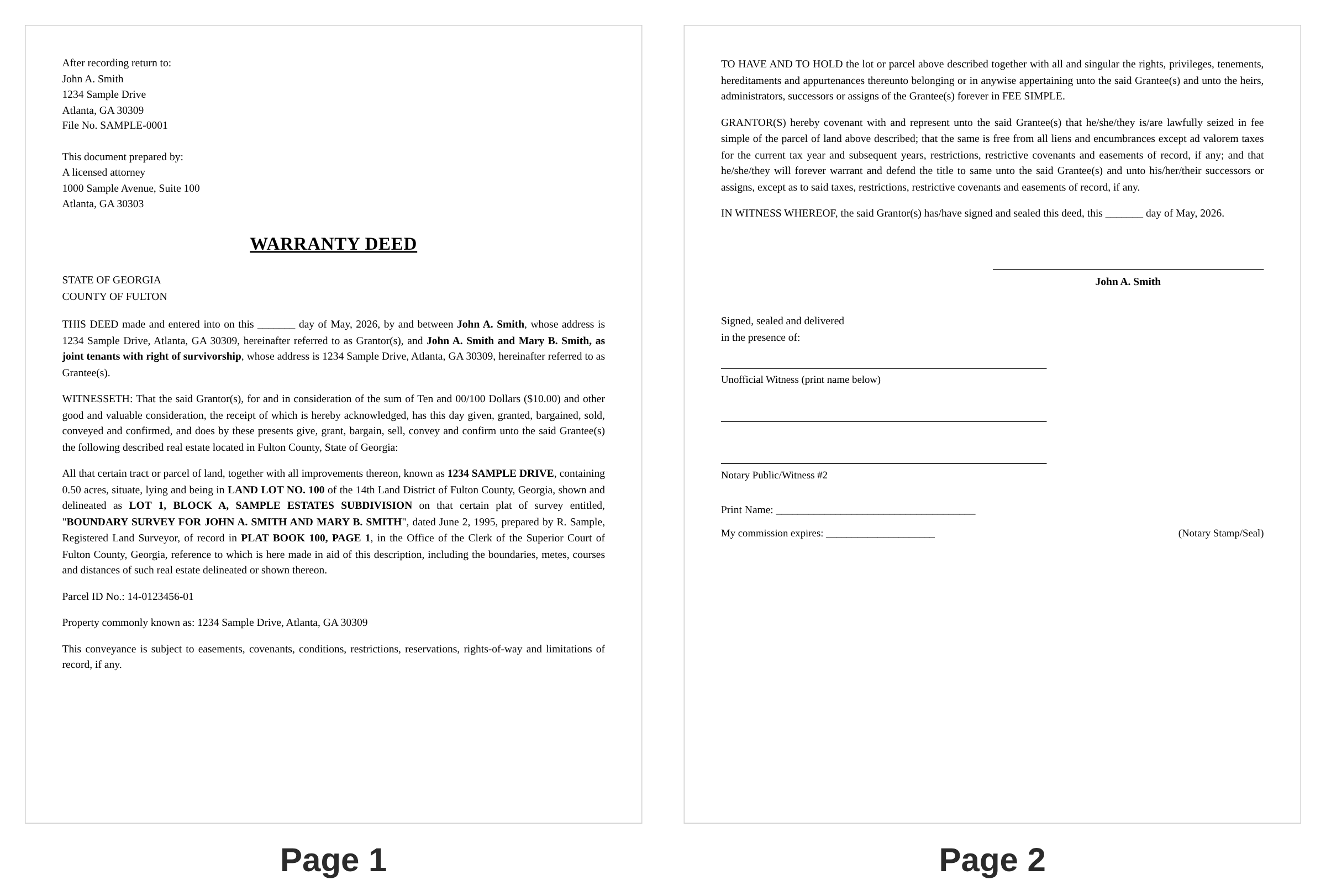
    We pull your title record, confirm the legal description, prepare the general warranty deed with all six Georgia warranty covenants, complete the PT-61 transfer form, and email everything with signing instructions.

  3. recording up to 1 week

    Step 3 — Sign, notarize, and we record it

    Grantor signs in front of a notary and one witness. Ship it back with our prepaid FedEx label. We eFile with the county clerk under HB 1292 and a recorded copy hits your inbox when it's official.

Quitclaim vs. limited warranty vs. general warranty

  Quitclaim Limited Warranty General Warranty
Warrants grantor actually owns it
Warrants title during grantor's ownership
Warrants title before grantor's ownership
Grantor liability after closing None Their period only Entire title history
Common GA use Family / trust / LLC Most GA residential sales Buyer-demanded; family premium
Cost to prepare with us $249 $249 $249

A general warranty deed gives the grantee the most protection of any Georgia deed type. It also gives the grantor the most ongoing liability. Pick this deed when the strength of the warranty is more important than the long tail of risk it creates for the seller — most often when the buyer has the negotiating leverage to demand it, or when a family seller wants to give a clean, complete deed as part of a larger family arrangement.

Is a general warranty deed right for you?

Good fit

  • Buyer specifically requested a general warranty deed in the purchase contract
  • Out-of-state buyer expecting their home state's deed norm
  • Premium family sale where the grantor wants to give the strongest deed possible
  • Closing where the buyer is not purchasing title insurance and wants deed-level protection
  • Confident estate administrators distributing long-tenured properties to heirs
  • Seller positioning the deed itself as a sales advantage on a FSBO listing

Not a fit

  • Sellers uncomfortable with open-ended warranty liability (use limited warranty + title insurance)
  • Family transfers with no money changing hands (use a quitclaim — warranty serves no purpose between trusting parties)
  • Estate of a property the grantor never personally owned long-term (use limited warranty)
  • Property outside Georgia
  • Investor flips (limited warranty is industry standard)

If you're being asked for a general warranty deed and you're not sure you should sign one, call us at (404) 939-6223 — a title examiner will walk you through what you'd be agreeing to.

What's included — flat $249

  • Title record review before drafting (we flag anything that should worry you about warranting it)
  • Custom-drafted Georgia general warranty deed with all six warranty covenants
  • PT-61 real estate transfer form (or exemption claim)
  • Plain-English signing instructions (notary + one witness)
  • Prepaid FedEx return label
  • County eFiling and recording (per HB 1292)
  • Recorded copy emailed to you
  • Lifetime customer support
  • ClearPath Guarantee (60 days, money-back)

Rush option — $329

Priority queue ahead of standard orders, deed drafted in 1 business day, priority recording support, and same-day response to questions.

We file in every Georgia county — including Fulton, Cobb, Gwinnett, DeKalb, and Chatham.

Georgia General Warranty Deed — Frequently Asked Questions

What's the difference between general and limited warranty in Georgia?
A limited warranty deed warrants title only for the grantor's period of ownership. A general warranty deed warrants the entire title history — every prior owner, every prior period — and the grantor is personally liable if a defect from any era surfaces. General warranty is the stronger deed; limited warranty is the more common Georgia residential deed.
How long does the warranty liability last?
Indefinitely. A general warranty deed creates ongoing covenants that don't expire on their own. If a title defect surfaces decades after closing, the grantee (or their successors) can still pursue the original grantor — or the grantor's heirs and estate — under the warranty covenants.
Does a general warranty deed replace title insurance?
Not exactly. Title insurance and a general warranty deed cover overlapping risks, but they work differently. Insurance pays the grantee directly without litigation against a former seller. A general warranty deed requires the grantee to actually find, sue, and collect from the grantor or their estate. Most attorneys recommend keeping title insurance even when a general warranty deed is used.
Why don't most Georgia closings use a general warranty deed?
Two reasons: (1) Georgia practice has standardized on limited warranty + title insurance because it allocates risk more efficiently, and (2) sellers don't want open-ended liability that survives closing and binds their estate. The combination of a limited warranty deed and an owner's title policy gives the buyer the same practical protection without the seller carrying lifetime risk.
Can I refuse to give a general warranty deed if a buyer requests one?
Yes. The deed type is a contract term — the buyer can request it, but you can refuse. If the purchase contract is already signed and specifies a general warranty deed, refusing could put you in breach. Call us at (404) 939-6223 before you sign anything, and we'll help you understand what you're agreeing to.
What are the six covenants of warranty?
Seisin (grantor owns it), Right to Convey (grantor has authority to transfer), Against Encumbrances (no undisclosed liens), Quiet Enjoyment (no superior claims), Warranty (grantor will defend the title), and Further Assurances (grantor will sign additional documents if needed). The first three address the moment of transfer; the last three create forward-looking obligations.
Does the grantee need to sign?
No. In Georgia, only the grantor signs the deed. The grantee accepts by recording. Execution requires the grantor's signature, a notary, and one witness.
Is a general warranty deed always the best deed for the buyer?
The strongest deed for the buyer, yes. The most appropriate deed for the transaction — not always. In a Georgia closing where the buyer is purchasing title insurance, a limited warranty deed delivers nearly identical practical protection while leaving the seller without lifetime liability. Insisting on a general warranty deed when title insurance is in place is often more about negotiation posture than actual risk reduction.
Will a general warranty deed remove me from the mortgage?
No. A deed transfers title; it doesn't touch the mortgage loan. If your name is on the loan, you're still on the loan after the deed is recorded. Removing yourself from the mortgage requires the new owner to refinance or get a written release from the lender.
How long does the full process take?
We draft your general warranty deed within 2 business days of receiving your property details. After you sign and return, your county records it in up to 1 week, depending on county workload. Total door-to-door: roughly 2 weeks.

Ready to prepare your Georgia general warranty deed?

  • $249 flat rate
  • Deed in 2 business days
  • 100% remote
  • ClearPath Guarantee

Other Georgia deed types we prepare